
January 28th, 2026 - Zed van der Vyver
The Ultimate Guide to Structural Beams in Thailand: Supporting Your Dreams (and Your Roof)
If you’re building a home in Thailand, the beams are the most critical part of the structure you’ll likely never see once the paint is dry. They aren't just "big sticks of metal or concrete"—they are the horizontal muscles that hold up your floors and keep your roof from becoming a rug.
Think of beams like the skeleton of your house. Just as your spine and ribs support your weight and protect your organs, beams (called Khan in Thai) carry the weight of the walls and ceiling, transferring it safely down to the columns and into the ground. Choosing the wrong type is like trying to hold up a heavy backpack with a toothpick—it won’t end well.
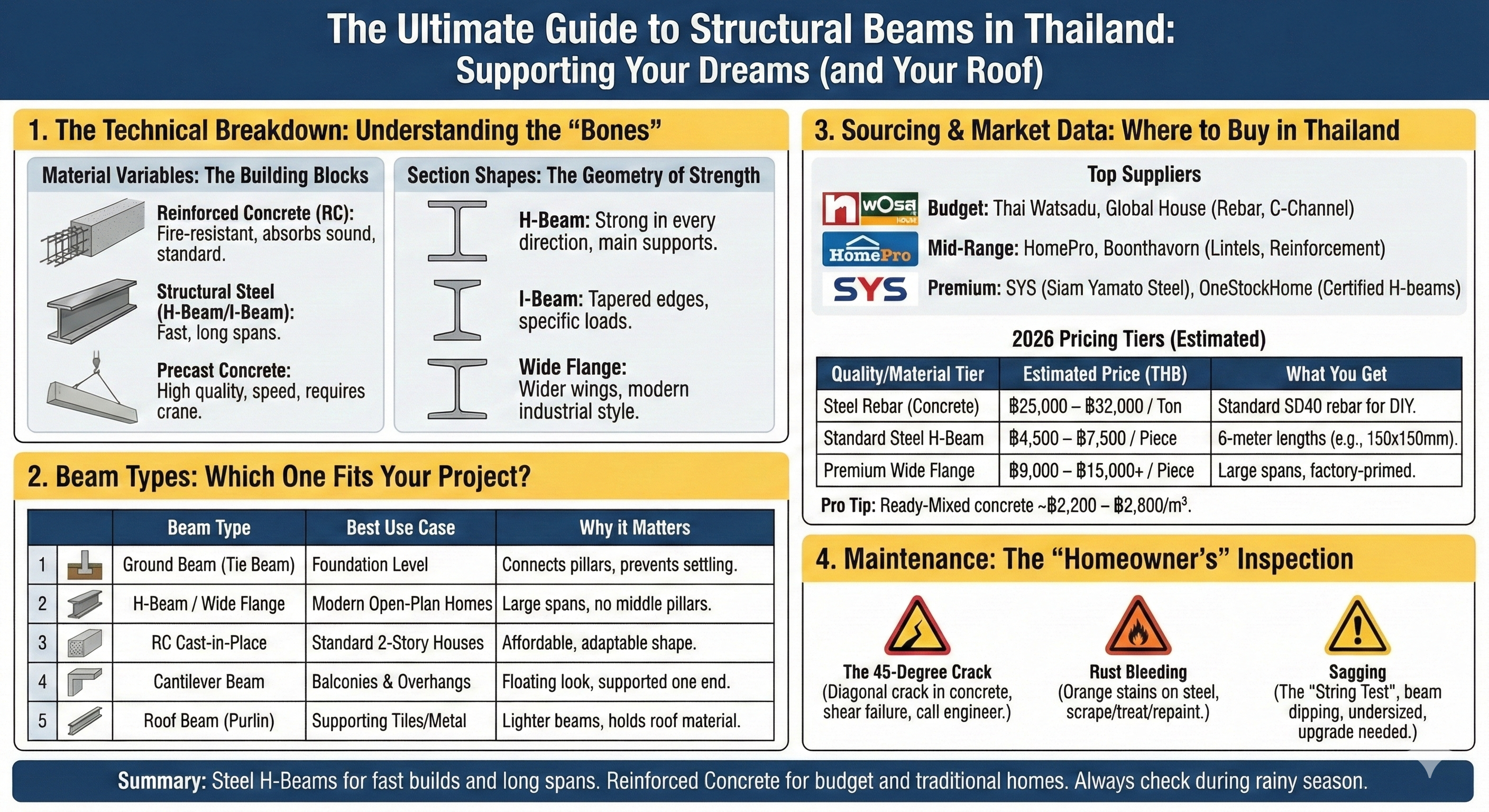
1. The Technical Breakdown: Understanding the "Bones"
In Thailand’s construction landscape, you’ll primarily choose between three materials. Each has a specific "job" depending on your budget and how fast you want to move in.
Material Variables: The Building Blocks
-
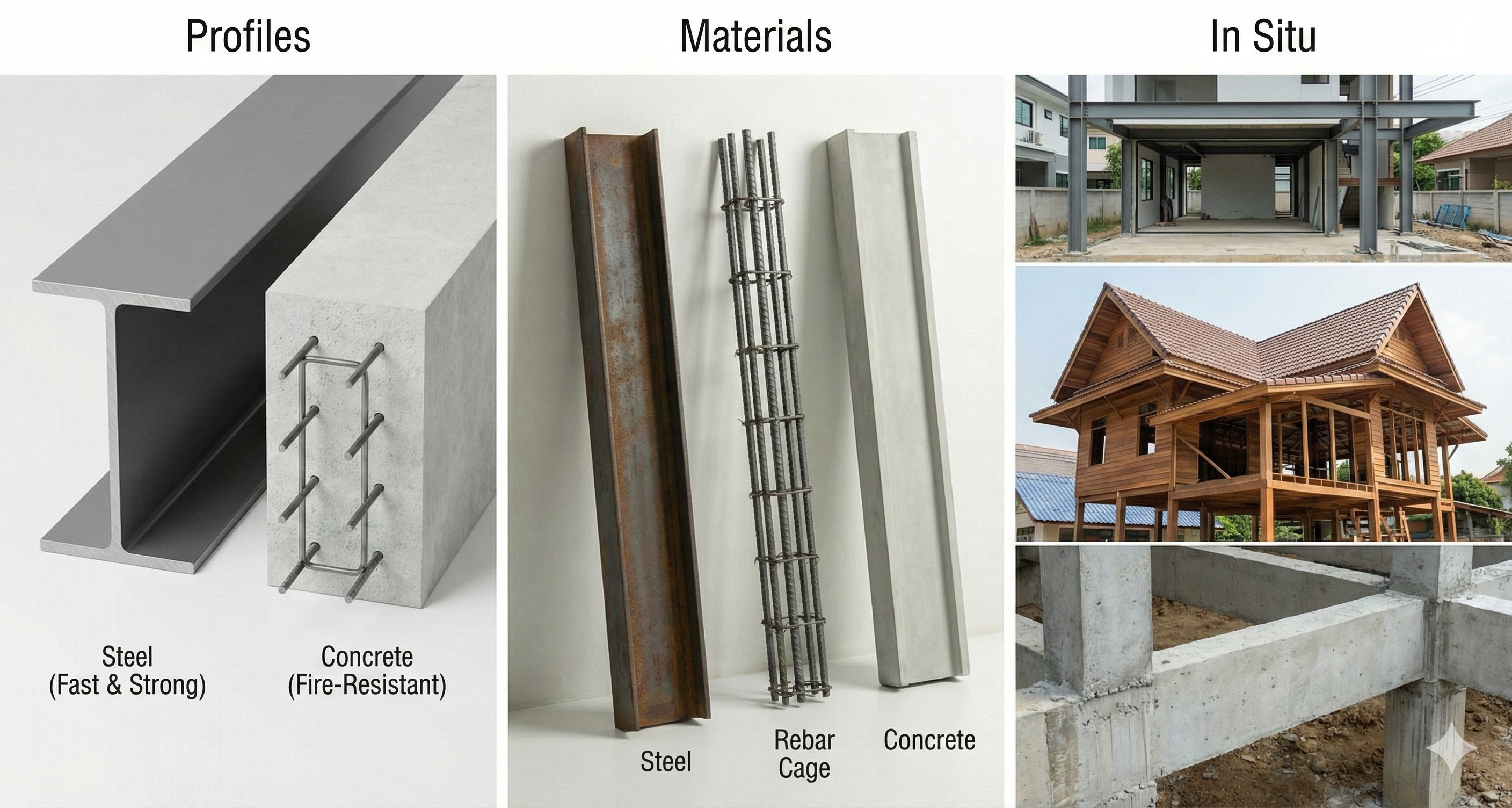
Reinforced Concrete (RC): The "Old Reliable" of Thailand. It’s a mix of concrete poured over a cage of steel rebar.
-
Why it matters: It’s incredibly fire-resistant and absorbs sound well, making it the standard for 90% of Thai residential homes.
-
-
Structural Steel (H-Beam/I-Beam): The "Fast & Strong" option. These are pre-made factory sections of high-strength steel.
-
Why it matters: Steel allows for "long spans" (huge rooms without middle pillars) and is much faster to install than waiting for concrete to dry.
-
-
Precast Concrete: These are beams made in a factory and trucked to your site.
-
Why it matters: They offer high quality control and speed, but you need a crane and good road access to get them to your land.
-
Section Shapes: The Geometry of Strength
-
H-Beam: Shaped like a capital "H." It’s a beast—strong in every direction and used for main supports.
-
I-Beam: Shaped like an "I." It has "tapered" (slanted) edges. Best for specific loads like overhead cranes or smaller, narrower supports.
-
Wide Flange: A more modern version of the H-beam with wider "wings." This is the go-to for modern, "industrial style" Thai homes.
2. Beam Types: Which One Fits Your Project?
Choosing a beam is about balancing the weight it needs to carry versus the distance it has to "jump" (the span).
| Beam Type | Best Use Case | The "Why it Matters" Factor |
| Ground Beam (Tie Beam) | Foundation Level | Connects all your pillars at the bottom to prevent the house from "settling" unevenly in soft Thai soil. |
| H-Beam / Wide Flange | Modern Open-Plan Homes | Perfect for that 8-meter wide living room without a pillar in the middle of your TV view. |
| RC Cast-in-Place | Standard 2-Story Houses | Most affordable for general construction. Can be shaped on-site to fit any weird corner. |
| Cantilever Beam | Balconies & Overhangs | These are supported at only one end. They allow for those cool "floating" balconies common in luxury villas. |
| Roof Beam (Purlin) | Supporting Tiles/Metal | Lighter beams (often C-Channel steel) that hold up your roof material and handle the wind. |
3. Sourcing & Market Data: Where to Buy in Thailand
You can buy standard beams at big-box retailers, but for major structural steel, you’ll often deal with specialized wholesalers.
Top Suppliers
-
Budget (The Standard Route): Thai Watsadu and Global House. Best for buying steel rebar (for concrete beams) and standard C-Channel roof beams in bulk.
-
Mid-Range (Ready-to-Use): HomePro and Boonthavorn. They carry pre-made lintels (small beams for over doors/windows) and high-quality reinforcement materials.
-
Premium (The Professional Grade): SYS (Siam Yamato Steel) and OneStockHome. These are the heavy hitters. If you want certified, high-grade H-beams that won't rust or bend, look for the "SYS" brand stamp.
2026 Pricing Tiers (Estimated)
Prices fluctuate based on global steel markets. Estimates are for standard residential sizes.
| Quality/Material Tier | Estimated Price (THB) | What You Get |
| Steel Rebar (Concrete) | ฿25,000 – ฿32,000 / Ton | Standard SD40 rebar for DIY concrete pouring. |
| Standard Steel H-Beam | ฿4,500 – ฿7,500 / Piece | 6-meter lengths (e.g., 150x150mm) for main framing. |
| Premium Wide Flange | ฿9,000 – ฿15,000+ / Piece | Large spans, factory-primed with rust protection. |
Pro Tip: In Thailand's 2026 market, "Ready-Mixed" concrete for beams usually costs around ฿2,200 – ฿2,800 per cubic meter. Factor in the cost of the steel "cage" inside it!
4. Maintenance: The "Homeowner's" Inspection
Beams are usually hidden, but you should check their health during your yearly "Rainy Season Review."
-
The 45-Degree Crack: If you see a diagonal crack in a concrete beam, call an engineer immediately. This is usually a sign of "shear failure" (the beam is struggling to hold the weight).
-
Rust Bleeding: On steel beams (or concrete ones with internal rust), you might see orange stains. This is "cancer" for your house. It needs to be scraped, treated with a rust converter, and repainted.
-
Sagging (The "String Test"): If a long beam looks like it’s "smiling" (dipping in the middle), it was likely undersized. This often happens when people switch from light zinc roofs to heavy clay tiles without upgrading the beams.
5. Summary & Next Steps
Building in Thailand requires beams that can handle heavy monsoon winds and the weight of reinforced concrete floors. If you want a fast build, go with Steel H-Beams. If you want a traditional, quiet home on a budget, Reinforced Concrete is your best friend.